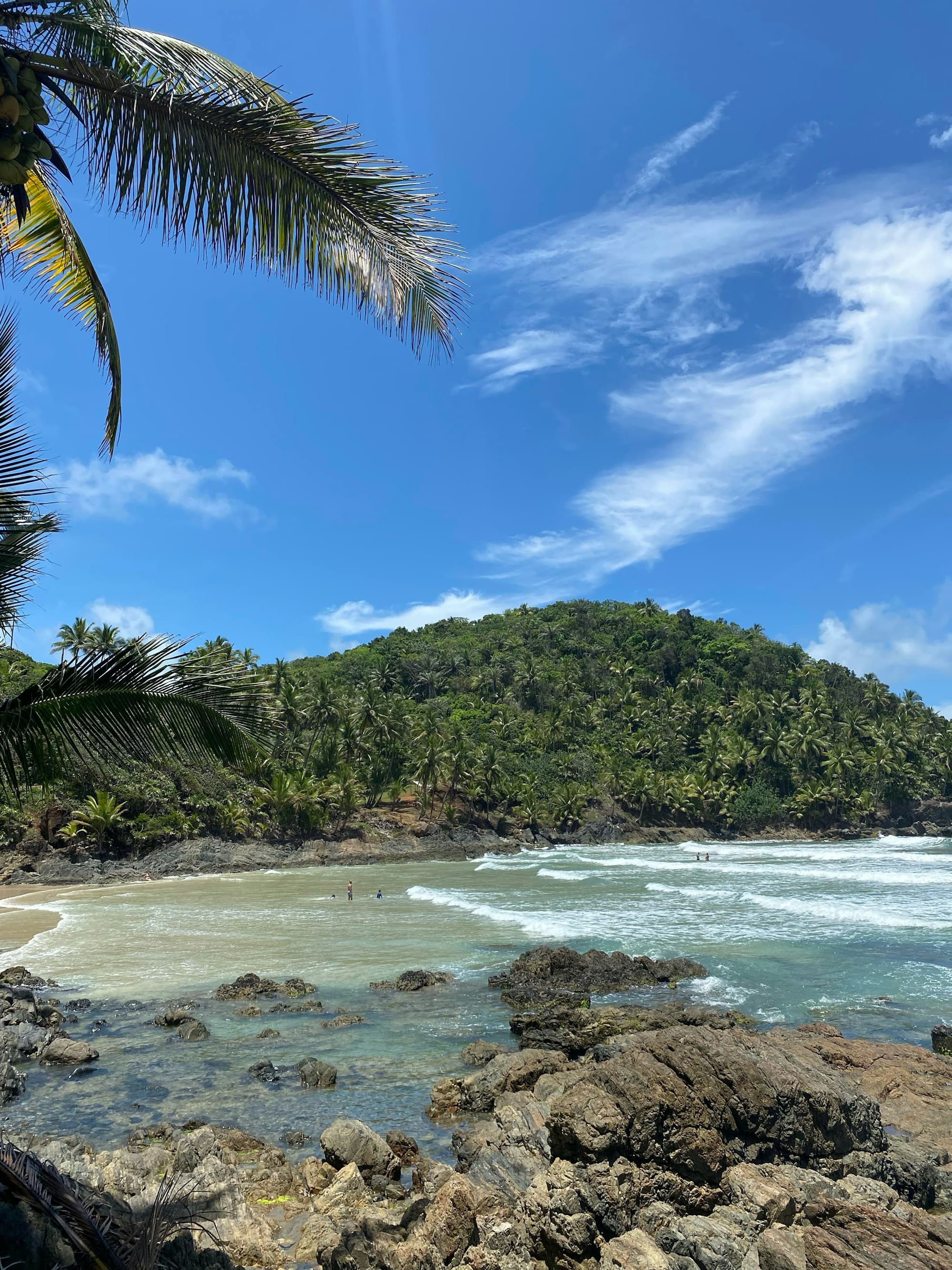
People arrive here with a list of beach names off a map and no idea which ones are five minutes away and which ones are a morning's commitment. It is the most useful thing to sort out first, because Itacaré's beaches divide cleanly into two kinds, and the division is not about how they look but about what they cost you to reach. Town beaches are a walk from your bed. Trail beaches are a bus or a car down the coast road and then a path through forest. Both are worth your time. They are not interchangeable, and picking the wrong one for the day you have is the usual way to waste an afternoon.
The town beaches
Four beaches sit within walking distance of the centre, and they run south in a line: Concha, Resende, Tiririca and Ribeira. You can string them together on foot in a morning. They are the ones to use on your first day, on a day the weather cannot make up its mind, and on any day you want to be back in town for lunch without planning it.
None of them is the postcard beach people picture when they think of Bahia. That beach is south of town and it takes a trail. What the town beaches give you instead is proximity: you can go, and if it is not working out you can leave, and neither costs you anything.
Praia da Concha
Praia da Concha is the sheltered one. The bay curls round on itself, which takes the ocean out of the water and leaves something closer to a lagoon at the near end. It is the obvious choice with small children, and the only town beach where the sea is reliably calm. It is also where a good share of the town's accommodation sits, so it doubles as a neighbourhood rather than just a strip of sand.
Resende, Tiririca and Ribeira
Carry on south and the coast turns. Praia do Resende is the first of the open beaches, backed by rock and palm. Tiririca is next and it is the one with a personality: short, fast, hollow waves that draw surfers all day and the whole town at sunset. If you want to understand the rhythm of the place in one evening, be on Tiririca at six.
Ribeira sits past it, quieter, with the headland behind it and rock in the shallows. It is the town beach people forget to mention, which is most of its appeal.
The trail beaches, south of town
Everything south of Ribeira runs along the BA-001, the coast road, and this is where Itacaré earns its reputation. Engenhoca, Havaizinho, Camboinha and Itacarezinho are the four names you will hear most. Every one of them is reached the same way: get dropped on the road, then walk down through forest to the sand. The walks are short by hiking standards and long by flip flop standards. Wear something you can lose a shoe in.
What you get for the effort is scale. These beaches are wide, backed by Atlantic forest rather than buildings, and empty enough outside high season that you will lose sight of the people you arrived with. Itacarezinho is the biggest and the one most worth a whole day.
Walking four beaches in a day
The classic day here links four of the trail beaches on foot, walking the coast between them rather than going back up to the road each time. It is the single best thing to do in Itacaré that costs nothing, and it is the reason most people who come for three days stay for a week.
- Start early. The middle of the day on an exposed beach is punishing and there is no shade on the sand.
- Carry water. There is no tap between beaches, and in low season there may be nobody selling anything either.
- Check the tide before you go. Some of the links between beaches are rock, and rock at high tide means going back up to the road.
- Take cash in small notes for the barracas, and do not count on a card reader working.
Which beach for which day
If you have small children or you want to swim without thinking about it, Concha. If you are learning to surf or you want to see the town at its most itself, Tiririca. If you have a full day and want the beach you came to Brazil for, Itacarezinho or Engenhoca. If it is your last morning and your bag is packed, Ribeira, because you can be back in fifteen minutes.
Surf
South and southeast groundswells run most consistently from April through September, and the water stays warm enough year round that nobody here owns a wetsuit. Tiririca is the town wave and it gets crowded because it is the one you can walk to. Praia do Resende is where people learn, because it is more forgiving and less busy, at the cost of the walk in. There is more on lessons and boards under what there is to do.
Currents, and what to actually watch
These are open Atlantic beaches. Outside Concha the water has real movement in it, there are no lifeguards on the trail beaches, and the beach that looks calmest from the sand is not always the one that is. Watch where the locals swim and swim there. If you are alone on a beach in low season, that is a reason to be more careful, not less.
Getting to the trail beaches
The coast road is served by buses through the day, and every accommodation in town can point you at the stop. A car makes the whole southern stretch easier and lets you leave when you want rather than when the bus does. If you are still working out how you are getting to Itacaré in the first place, start with how to get here, and if you are choosing which month to come, when to come covers what the sea does through the year.
Where to base yourself
Which beach you use most comes down to where you sleep, more than anything else. Concha and the centre are the two obvious bases and they give you different weeks. That is covered in where to stay and in the areas pages, and once you have picked a beach for the day, eating and drinking runs on its own weekly clock here.