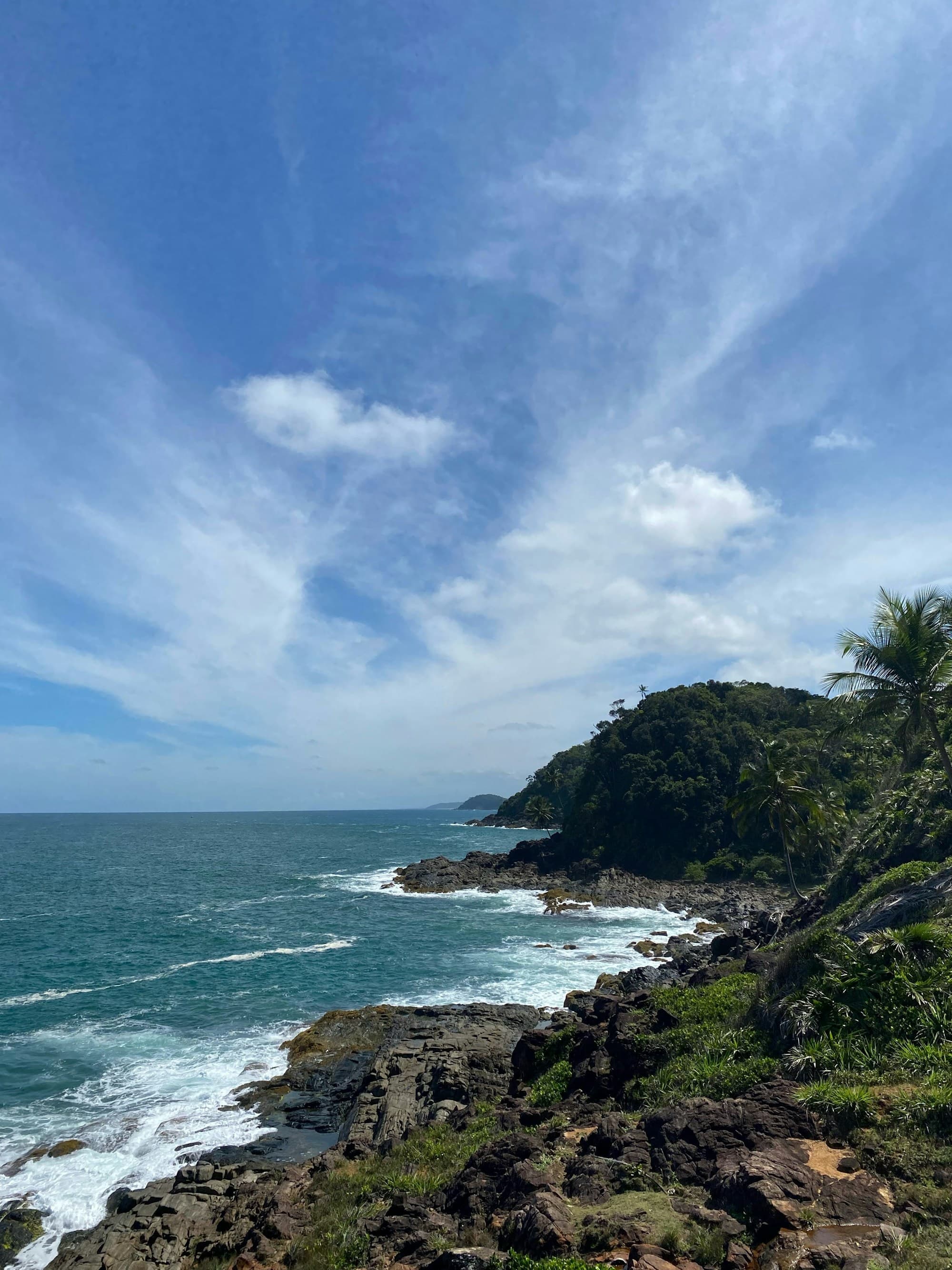
These two turn up on the same shortlist constantly, usually because they sit on the same stretch of Bahian coast and photograph similarly: palms, warm water, a headland. They are not variations on the same holiday. One is a car free island village reached by boat, the other is a working town on the mainland with forest behind it. Picking wrong is not a disaster, but you will spend the week adjusting.
The short version of the difference
Morro de São Paulo is on Tinharé island, off the mainland south of Salvador. There are no cars. Beaches are numbered rather than named, luggage moves by wheelbarrow, and the village is compact and geared almost entirely to visitors. Its reputation is nightlife, and the reputation is accurate.
Itacaré is a town of a few thousand people that surfers found and never left. It has a working centre, a fishing harbour, Atlantic forest at its back and beaches that take a walk through that forest to reach. It has plenty of nightlife, but it is a town first and a resort second.
Getting to each one
Which airport you are flying into will often settle this before anything else does. Morro is straightforward from Salvador, by boat across the bay. Itacaré is straightforward from Ilhéus, an hour and forty up the coast road. Going to the wrong one from the wrong airport costs you the better part of a day.
If your flights are already booked into Salvador and you want Itacaré, that is six to eight hours overland because the Baía de Todos os Santos is in the way. The whole calculation is set out in how to get to Itacaré.
The beaches
Morro's beaches are numbered outward from the village and get quieter as the number rises. They are close together and easy, and you can walk the lot in a day without much effort. Itacaré's split into the four you can walk to and the ones south of town that cost you a trail through forest, which is covered in the beaches guide.
Neither is better. Morro's are more convenient. Itacaré's are wilder and emptier, and you pay for that in walking.
Nightlife
Morro has the bigger reputation and deserves it: the village is small enough that the night is concentrated and hard to avoid. Itacaré's runs along Rua Pedro Longo and builds through the week rather than going every night, which is covered in nights out in Itacaré.
The practical version: if you want a guaranteed party on a Tuesday in low season, Morro. If you want a town that has a normal Monday, Itacaré.
Surf, forest and what else there is to do
This is where Itacaré separates from Morro rather than competing with it. The surf here is a genuine draw with a real season behind it, and the Atlantic forest, the river and the waterfalls give you a second landscape entirely. Morro is a beach village. Itacaré is a beach town with a forest attached, and that changes what a rainy day looks like.
With children, and with luggage
Morro's no cars rule is charming and it also means your bags go up a hill on a wheelbarrow. With small children and a lot of luggage that is a real consideration, and so is the fact that everything is close together once you are there.
Itacaré is flat through the centre and you can drive to your door, but the best beaches need a walk. Which of those trades suits you is the question, and it is worked through in Itacaré with children.
Doing both
It is done all the time and the route between them is well travelled, usually by a combination of boat and road. But it is not a short hop, and in a one week trip the transit will cost you close to two days. Over two weeks it makes sense. Over seven days you are better off picking one and using the time.
So which one
Morro if you are flying into Salvador, travelling to party, want everything walkable and close, and like the idea of a village with no traffic. Itacaré if you are flying into Ilhéus, surf or want to learn, want forest as well as beach, or want somewhere that is still a real town when the visitors thin out.
If you land on Itacaré, when to come decides the month and where to stay decides which beach is at the end of your street.
Common questions
- Is Itacaré or Morro de São Paulo better?
- They suit different trips. Morro is a car free island village, compact and easy, with the bigger party reputation. Itacaré is a working town with Atlantic forest behind it, better surf, wilder beaches and more to do beyond the sand. Which airport you fly into often decides it before anything else.
- Can you visit both Itacaré and Morro de São Paulo in one trip?
- Yes, and plenty of people do, but the journey between them is not a short hop. In a one week trip the transit will cost you close to two days. Over two weeks it makes good sense.
- Which is easier to reach from Salvador?
- Morro de São Paulo, by boat across the bay. Itacaré from Salvador is six to eight hours overland because the Baía de Todos os Santos sits in the way. Itacaré is the easy one from Ilhéus instead, at an hour and forty by road.
- Which has better beaches?
- Morro's are more convenient: numbered, close together and walkable in a day. Itacaré's are wilder and emptier, and the best of them cost you a walk through forest to reach. Neither is better in the abstract.
- Which is better for surfing?
- Itacaré, comfortably. It is a surf town with a real season running April to September, a dozen breaks inside twenty kilometres, a wave in walking distance of the centre and schools operating year round.
- Which is better with children?
- It depends on the trade you prefer. Morro has everything close together but no cars, so luggage moves by wheelbarrow and there are hills. Itacaré lets you drive to your door and has a sheltered bay at Praia da Concha, but the best beaches need a walk.